
What a Financial Plan Should Actually Do For You
Most people think a financial plan is a document.
A set of projections. A snapshot of what you should do. Save more. Spend less. Invest more. Something you review once and file it away.
That framing misses the point entirely.
A good financial plan isn’t a static output. It’s a decision-making framework designed to support you when things are uncertain, complex or emotionally charged.
It’s Not About Certainty
Life doesn’t move in a straight line. Income changes. Markets move. Businesses grow and stall. Health, family and priorities are constantly evolving as well.
A financial plan shouldn’t pretend otherwise.
The goal isn’t to set it and forget it. Why? Because the future is uncertain. Things change. A financial plan should evolve with your life. It should help you make better decisions as the future unfolds, especially when the right answer isn’t obvious.
That’s why the “set it and forget it” approach doesn’t work. It looks clean on paper, but it doesn’t help as the dynamics of your life shift.
There’s No Perfect Time
Very few people wake up one morning and say, “Now is the perfect time to hire an advisor.”
More often, the realization comes later after a rushed decision, missed opportunity, a big mistake, or a moment when the stakes felt higher than expected. By the time that clarity arrives, it can be too late.
When markets are stable and life feels manageable, it’s easy to postpone structure. When conditions change, there’s rarely time to build it from scratch.
That’s why planning is most valuable before it feels urgent. When decisions have to be made under pressure, what matters most is having a clear framework already in place.
What’s a Good Plan?
A good financial plan simplifies choices.
It answers questions like: How much risk is appropriate for you? How long should you stay invested? How do taxes affect each decision? How do we handle a market downturn?
Instead of reactively making decisions when things come up or when the market moves, a plan provides a framework that gives you a sense of stability. It narrows the range of reasonable actions and removes the temptation to second-guess yourself.
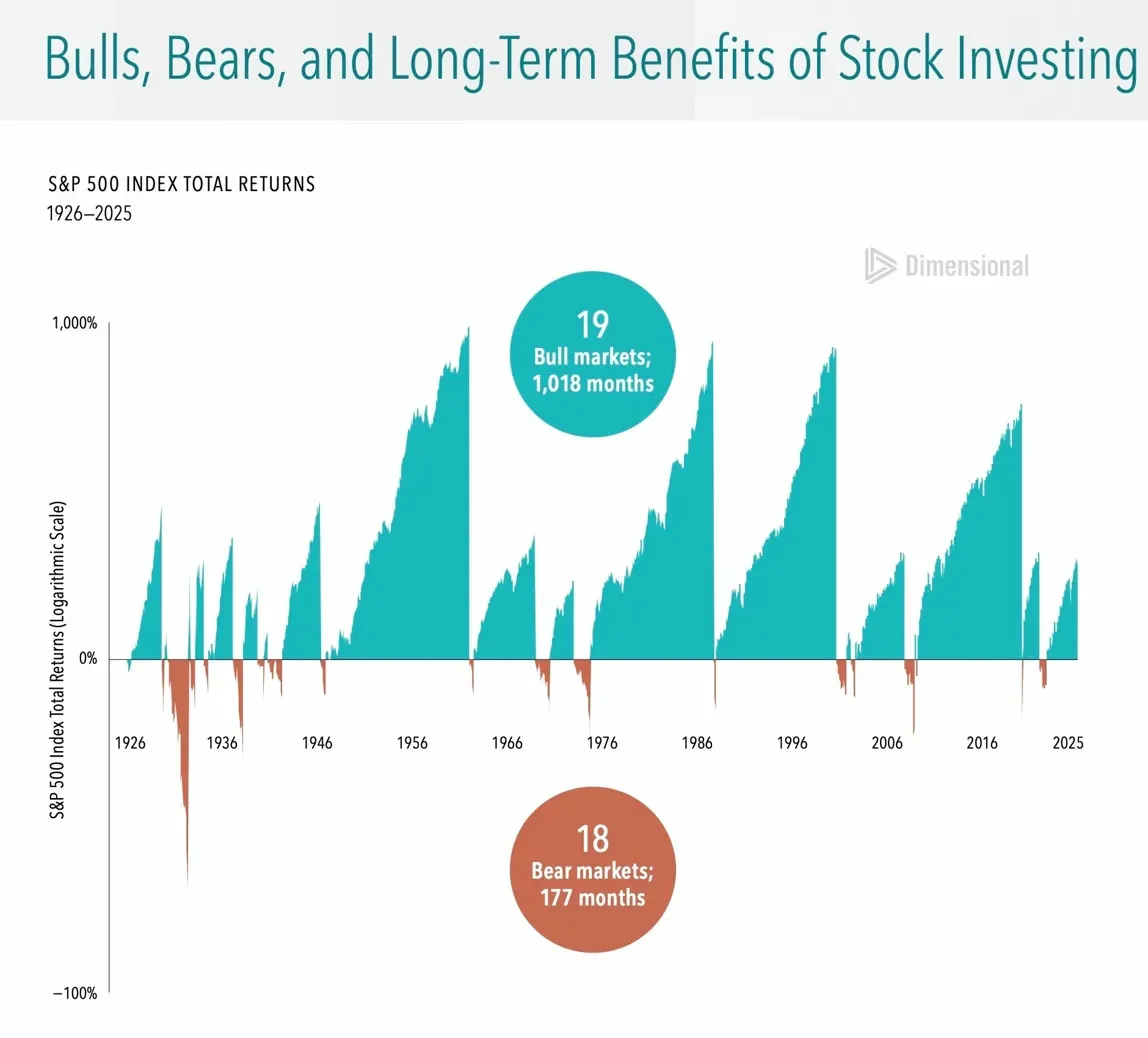
Looking at nearly 100 years of market history in the graphic below, bull markets have lasted 1,018 months (85%) while bear markets have lasted just 177 months (15%). Markets spend the vast majority of time moving upward. Yet, it’s during those brief bear markets that most investors make their costliest mistakes. They panic, sell near the bottom and lock in losses that could have been temporary. Working with an advisor won’t help you avoid downturns, but it does provide structure to weather the storm during the exact moments when most people abandon their plan.
Planning is About Coordination
Most financial mistakes aren’t caused by one bad decision. They come from a series of uncoordinated ones.
Investments made without considering taxes. Tax decisions without considering future income. Business decisions made without understanding how concentrated personal wealth has become.
A financial plan should connect these pieces.
Not to optimize every variable perfectly (which is impossible), but to make sure decisions work together as best they can, instead of working against each other.
That’s especially important when complexity increases.
A Good Plan Evolves
A financial plan isn’t something you “finish.”
It should adapt as your life does. What makes sense early in your career often doesn’t make sense down the road. What works during a growth phase may need adjustment during a consolidation or transition period.
The most effective plans are flexible by design. They’re reviewed, stress-tested and refined - not rebuilt from scratch every few years.
The Heavy Lifting
At its best, a financial plan does something subtle but powerful.
It creates enough structure that you don’t have to think about your finances constantly, while still giving you confidence that the important decisions are being made with intention.
It allows you to focus on your work, your family and the things you’re best at without feeling like your financial life is an afterthought.
That’s the standard I use when working with clients.
Not a plan that looks impressive on day one, but one that quietly supports better decisions over time, especially when life is pulling you in all different directions.
If you want that kind of framework in place, let’s talk.
This article is for general informational purposes and may not apply to every individual situation. If this is a question you’re actively considering, a personalized conversation can often bring clarity.
