
The Psychology of Money
One of the best books on investing behaviors is The Psychology of Money by Morgan Housel.
The book isn’t about how to beat the market, it’s not about stock charts, earnings or forecasts. And it’s certainly not about how to get rich quickly. It’s a book about how human behavior, emotions and personal history influence financial decisions more than math and intelligence.
The human side of things.
His perspectives on how to think about money are especially relevant for long-term investors, and a few of his ideas are worth sharing.
Volatility is the Price of Compounding
One of the book’s core ideas is that market declines are not a flaw in the system. They are the cost of participation.
Investing in markets have historically been a tremendous way to build wealth. But if you want to participate, you have to be willing to accept short-term pain. There is no version of investing where you earn equity-like returns without periods of loss, uncertainty and discomfort. Trying to avoid volatility can lead to missing out on the very returns people say they want.
The mistake many investors make isn’t experiencing volatility. It’s making reactive and emotional decisions when it occurs. The cost of compounding isn’t just drawdowns. It’s the discipline required to stay invested through them.
It’s one thing to say you are fine with drawdowns, but it’s another thing to experience them.
Getting Rich vs. Staying Rich
Housel makes an important distinction between building wealth and preserving it.
Getting rich often involves optimism, risk-taking, concentration, and frankly, some luck. Staying rich is about re-strategizing, protection and humility. One is an offensive strategy, and the other is a defensive strategy.
Many people succeed at the first part, but then fail at the second part by taking unnecessary risks once they no longer need to. This shows up frequently with wealthy people who have already “won the game” but continue playing as if they haven’t.
At some point, the goal shifts from maximizing upside to avoiding outcomes that can permanently alter your financial life.
Time Matters Most
Another key lesson is that compounding favors endurance, not intelligence.
Long-term success rarely comes from perfectly timed moves or exceptional insight. It comes from making repeatable, sound decisions over the long haul and staying invested long enough for compounding to do the heavy lifting.
The best example of this is illustrated by Warren Buffett. While he’s regarded as one of the greatest investors of all time, most of his wealth was accumulated later in life. An astounding 99% of his $140 billion fortune was accumulated after the age of 52. Let that sink in.
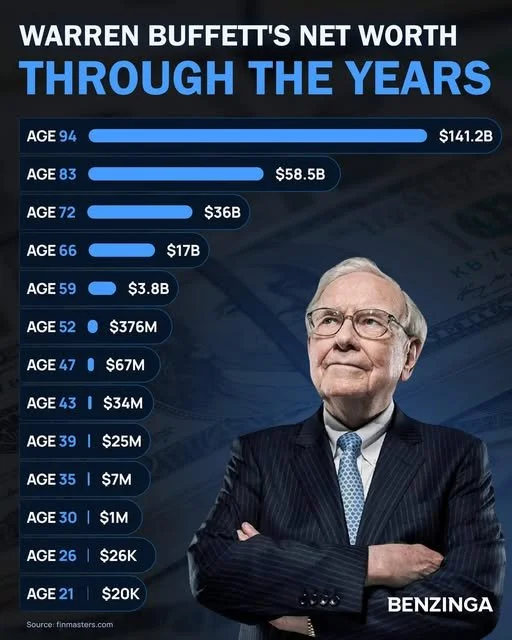
Yes, Warren Buffett is an extreme example. But it helps illustrate a key lesson: it’s not about timing the market, it’s about time in the market. Compounding does all the heavy lifting if you can let your money work for a long enough time period. Time, patience and consistency are far more powerful than complexity.
Bottom line: if you want to increase your odds of success, zoom out and increase your investment horizon.
Your Experiences Shape Everything
People don’t view markets objectively. They view them through the lens of their own experiences.
Someone who lived through the dot-com crash in the early 2000s or the Global Financial Crisis in 2008 may approach risk very differently than someone whose investing life began after 2010.
The same is true for business owners. An owner who relied heavily on debt financing during a rising interest rate environment is likely far more cautious about leverage than someone who built their business when borrowing costs were near zero.
Neither perspective is inherently right or wrong. But each person’s experiences directly influence their decisions and can lead to dramatically different outcomes.
Understanding your own financial history and how it influences your reactions is critical. Many investing mistakes aren’t driven by a lack of knowledge, but by emotional responses rooted in past experiences.
Independence is the Ultimate Goal
One of the most practical insights in the book is that money’s true value isn’t lifestyle or status, it’s leverage over your time and decisions.
Real wealth shows up quietly. It’s not about making or buying more. Real wealth is optionality. It’s the ability to say no to good or okay opportunities just to wait for the rare great opportunity. It’s the ability slow down when life demands it - whether it’s having a kid or taking care of an elder family member. It’s the ability to make choices freely without financial pressure forcing your hand.
From that perspective, investing becomes less about maximizing returns and more about designing a financial life that is resilient enough to ebb and flow with you as your life evolves.
The Real Takeaway
Taken together, these lessons point to a simple truth: above all else, successful investing is driven by your behavior.
Markets will always be uncertain. Volatility will always exist.
What matters is having a plan that accounts for the fact that you are a human with emotions, aligns with your goals and can be followed in any market regime - good or bad.
That’s where working with an advisor adds value. Not by avoiding drawdowns or predicting the future, but by helping you design a strategy that reflects these realities. One that balances risk, time, flexibility and behavior in a way that’s sustainable.
Helping clients apply these principles thoughtfully is a core part of how I work. If you are looking to gain clarity about your financial future, let’s have a conversation.
This article is for general informational purposes and may not apply to every individual situation. If this is a question you’re actively considering, a personalized conversation can often bring clarity.
